

Terms and Definitions Related to Textile Testing
Textile Testing Terminologies
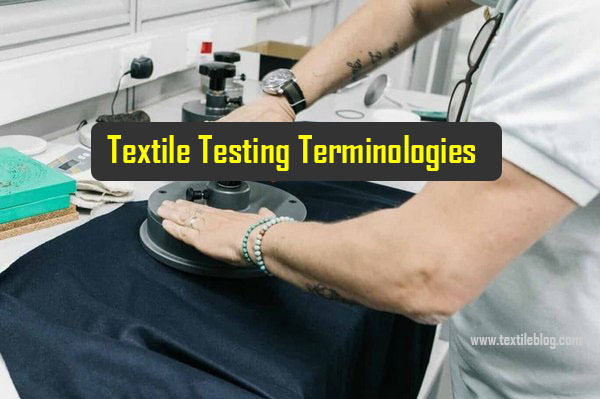
Textile testing refers to the process of evaluating the physical, mechanical, and chemical properties of fibers, yarns, fabrics, and finished garments using standard test methods. Before going for the testing part of the process, everyone must be aware of some standard terminologies related to textile testing. This article defines key terms and definitions used in textile testing, providing clarity for professionals, students, and enthusiasts in the field. Some of these are described here:
Quality:
When a person hears the word ‘quality,’ he instantly thinks of the possession of superior behavior and characteristics by any material. ISO defines this word slight differently. It says, “Ensemble of properties and characteristics of a product or a service which confer on it the capability to satisfy expressed or implicit requirements.” For example, a customer has a requirement of yarn of strength 10 cN/ tex, now if the yarn manufacturer produces the yarn of tex expecting the customer to be happy, this will not be so. The manufacturer is not actually producing the quality. Quality does not mean that one must produce the best quality. It is the ability of the product or service to meet the requirement. The customer is satisfied with the strength of 10 cN/ tex, then there is no point in producing stronger yarn for the same price.
Testing:
This is defined as, ‘A means of determining the capability of an item to meet the specified requirements by subjecting the item to a set of physical, chemical, environmental, or operating actions and conditions.’ For example, if it is needed to know whether a yarn possess tex strength or not, then some physical actions are applied to the yarn until it breaks. This action gives us an idea whether the yarn possesses the required strength or not. Similarly, if it is needed to know the blend percentage in a blended yarn, then some chemical actions, such as dissolution of components, is adopted. If someone wants to test the change in color under sunlight, then the material is exposed to that particular environmental condition, for example, sunlight. So basically, testing is done to determine whether that material is actually satisfying the required characteristics or not.
Inspection:
Unlike testing, the inspection has a wider remit and the testing is a part of the inspection process. It can be defined as, ‘The activities such as measuring, examining, and testing one or more characteristics of a product or service, and comparing these with specified requirements to determine conformity.’ For example, if it is needed to compare two batches of yarns, many aspects will be considered, for example, the quality of the bobbin, the strength of the yarns, the evenness of the yarns, the cleanliness of the yarns, the size of the yarn package, damages to the yarn packages, and so forth. So, it can be said that inspection is the checking of one or more characteristics of the product at one go to compare it with specified requirements to determine its conformity for a particular end use. Another example of inspection might be the end breakage study in the ring frame. This is not testing, but inspection. It can be done by counting the number of end breakages per hour in a particular ring frame and it can be compared with another ring frame or with the standard. The advantage of inspection is that it is an easy and quick method to know overall characteristics.