

Different Types of Fabric Finishes
Fabric Finishes
Fabric finishes are processes applied to textiles after weaving or knitting, to improve their appearance, feel, or performance. These finishes can be either functional (like making fabric water-resistant) or aesthetic (like giving it shine or softness).
Once the fabrics have been constructed, they may be finished in a variety of ways before they are sent to product manufacturers.
Fabrics are finished for a number of reasons; to add certain performance properties (e.g. prevent shrinkage), enhance the surface of the fabric or aesthetics (e.g. raise the nap) or encourage people to buy a product (e.g. starching).
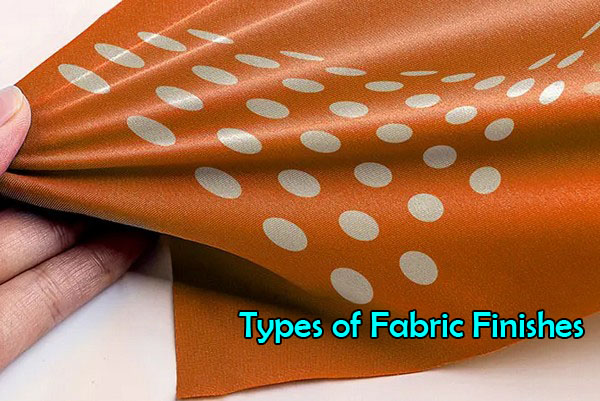
The performance and aesthetic finishes can be carried out by physical/mechanical or chemical/resinous means. The life expectancy of these finishes are in are four categories:
- Permanent – usually chemical and will not change throughout the life of the fabric.
- Durable – may last the lifetime of the product, but its effectiveness diminishes.
- Semi-durable – lasts through several washes or dry-cleaning processes, but it will eventually disappear though it is renewable.
- Temporary – very short-term; often used on end products to encourage people to buy them e.g. the starch on hankies, which is removed after the first few washes.
The finishes will, to some degree, affect the characteristics of the fabric.
Let’s explain some of the most common types of fabric finishes used in the textile industry.
Different Types of Fabric Finishes
Generally we can classify fabric finishes in the following three ways:
- Basic Finishes: Cleaning and tentering.
- Aesthetic Finishes: Shearing, brushing, mercerizing, calendering and puckering.
- Performance Finishes: Antimicrobial, anti-static, crease-resistant, easy-care, flame-resistant/retardant, hydrophilic, permanent pleat, plasma, mothproof, shrink-resistant, photo-protective, antioxidant, stain-resistant, stiffening, Trubenized, stonewashed, bio-stoned and bio-polished.